

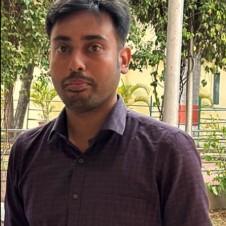
Inbasekar C
Chennai
Summary
Research Interest
Cell-ECM interaction
Effect of dicarbonyl stress on the ovarian cancer progression
Synthesis of fluorescent probes for the detection of glycating agents
Overview
7
7
years of professional experience
Work History
DBT-Research Associate
Indian Institute of Science
Bangalore
12.2024 - Current
Project 1: Glycation as a driver of ovarian cancer progression and metastasis
In this work, we developed a turn-on fluorescent sensor for real-time detection of MGO in biological systems.
Using time-lapse microscopy, this probe enables us to study the real-time dynamics and heterogeneity of MGO levels within ovarian cancer cells.
The probe was also used to track and characterise the novel high MGO and low glucose ovarian cancer cell populations, and their role in metastasis.
Project 2: Dicarbonyl quenching by tannic acid protects the matrix and restores organ and organismal homeostasis
In the present work, we investigated the impact of dicarbonyl stress on extracellular matrix biology and tissue architecture, using Hydra, murine mesenteries, endogenous cell-derived matrices, collagen, and basement membrane models.
Our studies revealed how dicarbonyl stress (MGO) remodels ECM architecture and perturbs tissue homeostasis.
We also demonstrated that small-molecule (MGO quencher) pretreatment can mitigate MGO-induced dicarbonyl stress, restore ECM integrity, and maintain functional balance.
Project 3: Effect of dicarbonyl stress on glucose trafficking
In this work, we used fluorescent probes to measure how MGO kinetics affect glucose trafficking and uptake in the insulinoma cell lines.
DST-Research Associate
Indian Institute of Science
Bangalore
05.2024 - 12.2024
CSIR-Senior Research Fellow
Council of scientifc and industrial research
Chennai
04.2019 - 04.2022
- Synthesised green crosslinkers and polymers to enhance collagen stabilization
Education
Doctor of Philosophy - Faculty of Technology
Anna University
Chennai, IN-TN2024
Master of Technology - Leather Technology
Anna University
Chennai, IN-TN2016
Bachelor of Technology - Biotechnology
Anna University
Chennai, IN-TN2014
Skills
- Data collection and analysis
- Research paper presentations
- Experiment designing
- Project management
- Scientific communication
- Grant writing
Accomplishments
- PhD Thesis- Highly recommended
Research Skills
- 3-D cell culture and organoids
- Stable Knockout cell lines using CRISPR-CAS9
- Synthesis of fluorescent probes
Timeline
DBT-Research Associate
Indian Institute of Science
12.2024 - Current
DST-Research Associate
Indian Institute of Science
05.2024 - 12.2024
CSIR-Senior Research Fellow
Council of scientifc and industrial research
04.2019 - 04.2022
Doctor of Philosophy - Faculty of Technology
Anna University
Master of Technology - Leather Technology
Anna University
Bachelor of Technology - Biotechnology
Anna University